
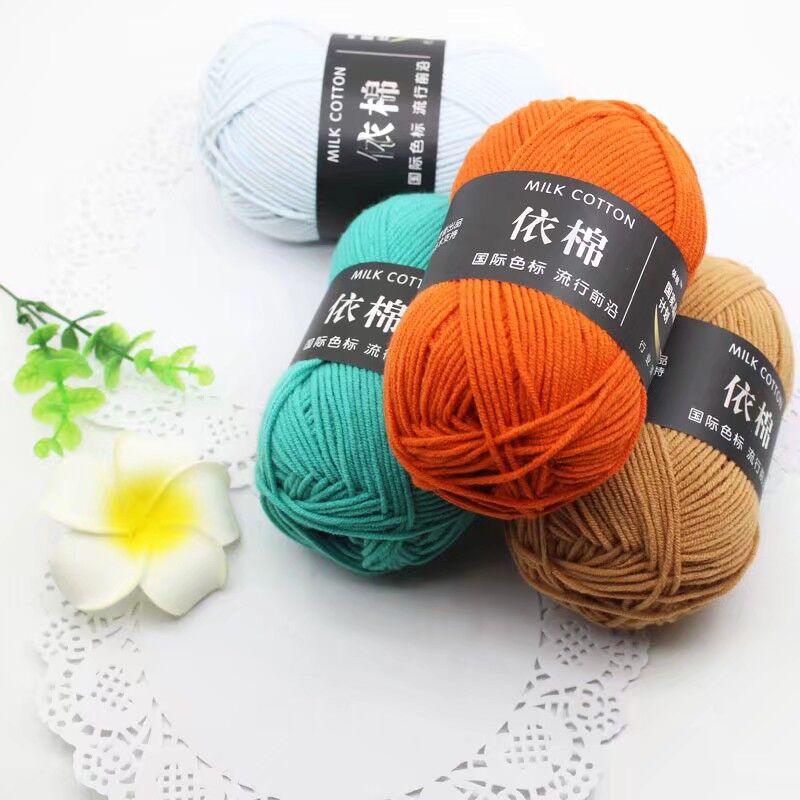
For a yarn pack quotation, state exactly what the priced unit counts and ask the supplier to repeat that unit in the offer and packing proposal. Keep the individual wound unit, the number of units in a pack and any declared weight or length separate. A photograph showing several yarn balls does not establish that they form one supplied pack or that each pictured color is included.
Use the picture to identify the reference, not the pack
The official 4-Ply Milk Cotton gallery includes an arrangement of several yarn balls with printed bands and decorative props. It helps identify the catalogue reference, but it does not define a sale unit. Ask the supplier whether the quotation concerns an individual ball, another named wound form or a separately described pack. Keep that response linked to the item and sample reference.
Specify the intended count in plain language before comparing prices. If a supplier uses another term for its supply unit, retain that term and ask it to describe the contents. Do not replace an unfamiliar unit with an assumed equivalent. A comparison becomes much easier when each offer explains what the buyer would actually receive for the quoted line.
Separate the unit count from weight and length
A count identifies how many named units belong to the proposed supply. Weight and length statements describe different characteristics and need their own basis. The product page contains a weight and length notation, but the buying record should ask whether a value is nominal, observed on a sample or agreed for the offer. Do not turn a catalogue notation into an accepted tolerance without confirmation.
Where a weight is quoted, ask what the supplier includes in it and how the sample or pack is identified. Packaging and supporting materials should not be silently mixed with a yarn-only description. For a length statement, ask which unit and offered item it describes and what record supports it. The buyer does not need to invent a conversion to make an incomplete offer appear comparable.
Field | Question for the supplier | Record to keep
Priced unit | What exactly does this quotation line count? | Named unit and contents
Pack quantity | How many named units belong to the proposed pack? | Packing proposal linked to the item
Weight statement | What is included and what is the declared basis? | Item-specific weight explanation
Length statement | Which offered unit does the statement cover? | Applicable supplier record
Sample reference | Does the proposed pack match the reviewed sample? | Dated sample and pack identifiers
Make assortment and identification separate questions
Ask whether a pack contains one selected variation or a separately agreed assortment. Record the supplier variation references rather than treating photograph colors as available order choices. A gallery arrangement can show how the product is presented without confirming current supply, matching lots or an assortment structure. Keep any proposed assortment as a written option that the supplier can confirm or correct.
Request a packing view that shows how individual units and the outer pack are identified. The buying team should be able to connect each named variation to the packing list. If several references share one outer package, ask how they are separated and counted. This is a contents and identification question; it does not establish a color consistency or other performance result.
Compare quotations on an explicitly aligned basis
Before ranking offers, check that their item references, counted units and included packaging are aligned. Where they differ, show the difference instead of forcing them into the same column. A quotation for an individual yarn unit and a quotation for a named mixed pack can both be clear while remaining unsuitable for a direct price comparison without further information.
If the buyer prepares a calculation from supplier-confirmed quantities, retain the source values and assumptions alongside it. Keep that calculation distinguishable from a measured sample record or a supplier guarantee. When a value is missing, ask for clarification rather than filling it from a familiar catalogue convention. The comparison should remain traceable to the actual offered supply.
• State the counted unit before comparing commercial lines.
• Keep pack quantity, weight and length as separate declarations.
• Confirm variation references without assuming photographed colors are available.
• Retain the basis of any buyer calculation and all unresolved fields.
Approve a packing reference that can be received
Once the scope is agreed, keep a pack reference with the item ID, contents and applicable supplier statements. Request an identifiable sample packing record so receiving staff know what the approved arrangement describes. If a later proposal changes the pack contents or its unit definition, give the change a revision instead of updating the earlier record without explanation.
Send remaining questions through the official contact channel with the catalogue link and pack reference. The final response should make clear which quantities were confirmed, which values are supplier declarations and which matters remain unavailable. Keep prices, delivery arrangements and other commercial terms subject to their own confirmation. A useful pack record removes ambiguity without inventing a standard package from a product photograph.
Frequently asked questions
Does a photograph of several balls define one sales pack?
No. Ask the supplier to identify the priced unit and the proposed pack contents. Decorative arrangements and props do not define supplied quantities.
Can catalogue weight and length figures be treated as agreed limits?
Not without confirmation. Record their stated basis and ask what applies to the actual offer, including any separately agreed measurement or acceptance terms.
What if two quotations count different units?
Keep the difference visible and request the missing contents information. Do not rank them as equivalent offers or invent a conversion from an assumed pack size.
Product and contact references
Catalogue reference: confirm matching item: https://yayingyarn.com/product/4-ply-milk-cotton/
Related catalogue reference: https://yayingyarn.com/products/?product_filter=%e8%8a%b1%e5%bc%8f%e7%ba%b1%e7%ba%bf
Contact Yaying Yarn: https://yayingyarn.com/contact/
Yaying Yarn blog: https://yayingyarn.com/blog/