
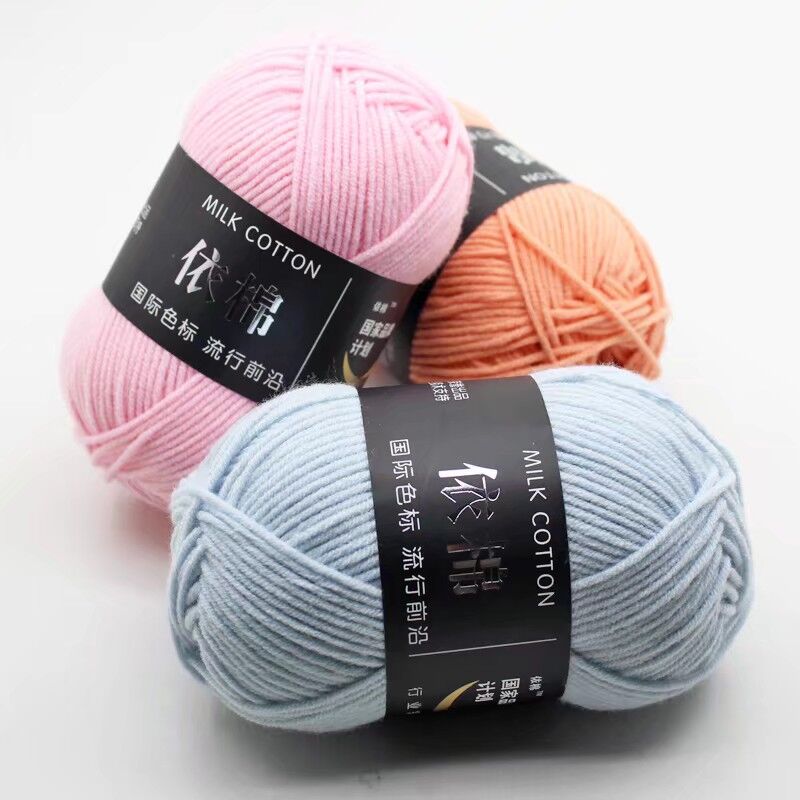
For a yarn sample enquiry, keep the catalogue name, the words printed on the band and the supplier fibre declaration in separate fields. Ask which declaration applies to the exact offered item and sample revision. A name such as Milk Cotton can identify a catalogue reference, but the name alone does not establish cotton content, another fibre ingredient or a confirmed blend percentage.
Start with the exact catalogue reference
The official Yaying Yarn page titled 4-Ply Milk Cotton provides a concrete reference for an enquiry. Its photograph shows yarn balls with printed bands, while the page description uses acrylic wording. Record those observations without silently deciding that a title, category or photograph is the final composition specification. The useful purchasing question is which written declaration the supplier applies to the actual offer.
Give the enquiry a sample reference and retain the product link and selected image. If the supplier proposes a similar yarn under another name, assign a separate alternative reference. Keeping names and alternatives visible prevents a later conversation from mixing two products merely because their colors or packaging look similar. The first record should make the requested identity understandable before asking the supplier to resolve its technical description.
Keep three kinds of wording distinguishable
A catalogue title locates a listing. A printed band helps identify a photographed or supplied sample. A supplier declaration states the information the supplier is prepared to confirm for an offered item. These records can be linked, but they are not interchangeable. Ask the supplier to explain any difference instead of replacing the original wording with an assumption that appears more convenient.
Use the supplier response to identify the scope of the declaration. Ask whether it applies to the named offered item, the submitted sample or a broader collection. Where a percentage or fibre name is supplied, retain the exact applicable reference and document revision. Do not extend a statement from one yarn to other pictured colors, constructions or categories without explicit confirmation that those items share the same declared scope.
Record field | What it identifies | Supplier clarification
Catalogue title | The page used for the enquiry | Exact offered item reference
Printed band | Words visible on the selected sample image | Relationship to the submitted sample
Fibre statement | Supplier-declared information | Applicable item and revision
Supporting record | Document supplied for review | Scope, date and item linkage
Ask for an item-specific declaration record
Request a written statement that names the offered item and identifies the sample under discussion. Ask the supplier to show the connection between its item code, the quotation and any supporting document. A general brochure can provide background, but its scope may not establish the composition of the particular sample. If the relationship remains unclear, mark it as an open question rather than calling the document verified.
Keep the distinction between a supplier declaration and independent supporting evidence. If a report is supplied, check which item and scope it actually names and record any unresolved applicability question. This is a document-linking task, not an invitation to invent a certification result or a universal material conclusion. A photograph of a yarn ball cannot replace an item-specific written response about its composition.
Compare responses without rewriting the evidence
Build a comparison sheet with separate columns for the original catalogue wording and the confirmed supplier response. Retain both when they differ. Ask whether the difference represents an alternative product, a corrected description or a naming convention, and keep the explanation with the relevant reference. The buyer should be able to understand the change without searching through disconnected messages.
Do not use a soft appearance, a smooth strand or a color as evidence of an ingredient or performance. The same caution applies to phrases about skin comfort, care behavior or suitability for a project. If those matters are relevant to the purchase, identify them as separate requirements and request applicable evidence. They should not be treated as already established by the catalogue title or sample photograph.
• Keep catalogue names and declared composition in different fields.
• Link every statement to an exact offered item or sample.
• Retain conflicting wording and the supplier explanation.
• Leave unsupported composition or performance questions open.
Freeze the agreed identity for the quotation file
After clarification, record the agreed item reference, declaration revision and remaining limitations in the quotation file. Ask the supplier to identify any later substitution against that record. A changed band or familiar product name should not automatically be treated as the same agreed supply. Keep the earlier version so the purchasing team can follow how the item definition was established.
Send unresolved questions through the official contact channel with the product link and sample reference attached. A concise request for confirmation is more useful than repeating promotional wording as a specification. Keep commercial terms, availability and any additional evidence requirements separate. The resulting file should show what the supplier has confirmed, what was merely observed and what the buyer still needs before accepting the offer.
Frequently asked questions
Does the phrase Milk Cotton verify cotton content?
No. In this enquiry it is part of the catalogue reference and visible band wording. Ask for the supplier declaration applicable to the exact offered item.
Should conflicting catalogue and description wording be deleted?
No. Retain the original observations and the supplier clarification. This makes it clear whether the offer changed or the description was corrected.
Does a declaration for one sample cover every pictured color?
Not automatically. Ask which item references and variations the statement covers, and record that scope rather than extending it from appearance alone.
Product and contact references
Catalogue reference: confirm matching item: https://yayingyarn.com/product/4-ply-milk-cotton/
Related catalogue reference: https://yayingyarn.com/products/?product_filter=%e8%8a%b1%e5%bc%8f%e7%ba%b1%e7%ba%bf
Contact Yaying Yarn: https://yayingyarn.com/contact/
Yaying Yarn blog: https://yayingyarn.com/blog/